EU Deforestation Law: Coffee Import Rules in 2026
The global coffee industry is facing its most significant regulatory shift in decades. As of late 2025, the European Union’s deforestation regulation (EUDR) is transforming how coffee is imported, traded, and sold across Europe. For roasters, importers, and producers alike, understanding these coffee importing regulations EU deforestation traceability requirements is no longer optional. It is a legal necessity that affects the entire supply chain from farm to cup. This article explains exactly what the regulation demands, how it impacts your business, and what steps you must take to remain compliant while continuing to source exceptional coffee.
What the EU Deforestation Regulation Requires
The European Union Deforestation Regulation (EUDR) came into force in June 2023, with compliance obligations starting for most operators by early 2026. The regulation targets seven commodities linked to deforestation: cattle, cocoa, palm oil, soy, rubber, wood, and coffee. For coffee importers, the core requirement is simple: every shipment entering the EU must be proven to be deforestation-free. This means that the coffee must not have been grown on land that was converted from forest to agricultural use after December 31, 2020.
The regulation applies to all coffee products classified under HS codes 0901 (coffee, whether or not roasted or decaffeinated) and 0902 (coffee substitutes containing coffee). This includes green beans, roasted beans, ground coffee, and instant coffee. Importers must submit a due diligence statement to EU authorities before each shipment, demonstrating that the coffee meets the deforestation-free standard. The statement must include detailed geolocation data for all plots where the coffee was grown, along with proof that local land-use laws were followed.
Geolocation and Traceability Requirements
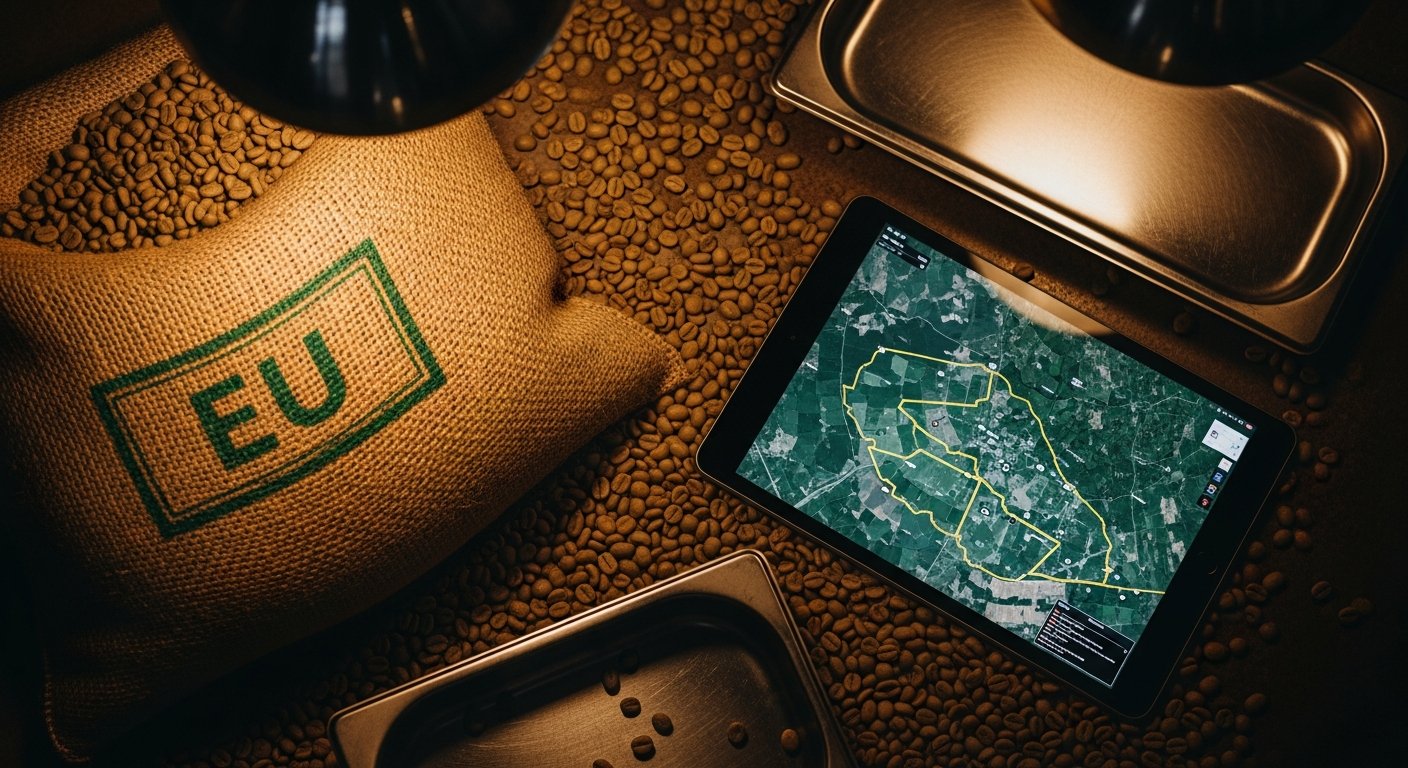
The most challenging aspect of coffee importing regulations EU deforestation traceability is the geolocation mandate. For any plot of land larger than 4 hectares, importers must provide polygon coordinates that map the exact boundaries of the farm or plantation. For smaller plots, a single pair of latitude-longitude coordinates is acceptable. This data must be collected and stored for at least five years after the import date. The European Commission will use satellite imagery and third-party audits to verify these claims, so accuracy is critical.
For smallholder farmers, who produce roughly 80% of the world’s coffee, this requirement poses a major hurdle. Many lack the technology or resources to provide precise geolocation data. As a result, importers are increasingly partnering with cooperatives, certification bodies, and technology providers to map farms and digitize supply chain records. In our guide on what kind of coffee do I need for my Newco LCD machine, we discuss how traceability starts at the farm level, which is exactly the foundation the EUDR seeks to strengthen.
Who Must Comply and What Are the Penalties
The regulation applies to two types of entities: operators and traders. Operators are companies that first place coffee on the EU market, such as importers, roasters, and large distributors. Traders are downstream businesses that make coffee available on the market after it has already been placed, including wholesalers, retailers, and online sellers. Both categories must exercise due diligence, but operators bear the primary legal responsibility.
Penalties for non-compliance are severe. EU member states are required to impose fines that are proportionate to the environmental damage caused and the economic benefit gained from non-compliance. Maximum fines can reach at least 4% of a company’s annual turnover in the relevant member state. Additionally, non-compliant coffee can be confiscated and destroyed, and repeat offenders may face temporary bans from importing coffee into the EU. These penalties apply across all 27 EU member states, creating a unified enforcement mechanism.
Beyond fines, there is a reputational risk. Consumers and business buyers are increasingly aware of deforestation issues. A company found violating the EUDR could lose contracts with major retailers or face public backlash. For specialty coffee roasters, where origin stories and sustainability are core brand values, the reputational damage could be devastating.
Steps to Achieve Compliance
Navigating coffee importing regulations EU deforestation traceability requires a structured approach. Here are the essential steps every importer and roaster should take:
- Map your supply chain. Identify every producer, cooperative, and intermediary in your coffee sourcing network. Create a complete list of all origins, farms, and plots you source from.
- Collect geolocation data. Work directly with producers or cooperatives to obtain accurate polygon or point coordinates for each plot. Use mobile apps or GPS devices where necessary.
- Verify legal compliance. Obtain documentation proving that the land was used legally under local laws regarding land use, labor rights, and environmental protection.
- Establish a due diligence system. Set up a process to collect, store, and manage all required information for each shipment. This system must be auditable by EU authorities.
- Submit due diligence statements. Before each import, file a statement with the competent authority in the EU member state where the coffee will first enter the market.
These steps are not a one-time exercise. The EUDR requires continuous monitoring and annual reviews of your due diligence system. You must also report publicly on your efforts to address deforestation risks in your supply chain. For most companies, this means investing in dedicated compliance software or hiring a sustainability manager.
How Technology Is Reshaping Coffee Traceability
The scale of the EUDR’s data requirements has accelerated innovation in coffee traceability technology. Several platforms now offer end-to-end solutions that integrate farm mapping, supply chain documentation, and due diligence statement submission. These tools use blockchain, satellite imagery, and AI to verify that coffee is deforestation-free. For example, some platforms cross-reference geolocation data with historical satellite images to ensure no forest clearing occurred after December 2020.
For smallholder cooperatives, mobile-based solutions are emerging. Farmers can use smartphones to capture GPS coordinates and upload photos of their land. These data points are then aggregated by cooperatives and passed to importers. This approach reduces the burden on individual farmers while maintaining the accuracy that the EUDR requires. Larger roasters are also investing in direct relationships with producer groups, bypassing intermediaries to gain better visibility into their supply chains.
The cost of these technologies is falling, but it remains a barrier for smaller importing companies. However, the cost of non-compliance is far higher. Investing in traceability now not only ensures legal compliance but also creates a competitive advantage. Buyers and consumers increasingly demand transparency, and companies that can prove their coffee is deforestation-free will command premium prices.
Impact on Coffee Prices and Supply Chains
The EUDR is likely to increase the cost of importing coffee into Europe. Compliance costs include technology investments, staff training, third-party audits, and potential legal fees. These costs will be passed down the supply chain, meaning that roasters and consumers will pay more for EUDR-compliant coffee. Estimates suggest a price increase of 5% to 15% for green coffee in the short term, with specialty coffee potentially seeing higher increases due to the complexity of tracing small lots.
Supply chain disruptions are also possible. Producers who cannot meet the traceability requirements may lose access to the EU market, which accounts for roughly 30% of global coffee imports. This could lead to shortages of certain origins, particularly from regions with weak land governance or fragmented smallholder systems. Countries like Ethiopia, Uganda, and Vietnam may face challenges, while Brazil and Colombia, which have more established land registration systems, may adapt more quickly.
Roasters should start diversifying their sourcing strategies now. Building relationships with multiple origins and cooperatives reduces the risk of being cut off from a single source. It also allows roasters to test different traceability systems and find what works best for their business model. The EUDR will reward flexibility and preparedness.
Practical Advice for Roasters and Importers
If you are a coffee roaster or importer, start your compliance journey today. The deadline is approaching rapidly, and the process of mapping farms and collecting data can take months. Begin by auditing your current supply chain. Identify which producers you source from and whether they can provide geolocation data. If they cannot, reach out to them now to discuss solutions. Many cooperatives are already working with NGOs and technology providers to meet EUDR requirements.
Next, review your contracts with suppliers. Ensure that new contracts include clauses requiring deforestation-free certification and data sharing. Existing contracts may need to be renegotiated. Work with a legal expert who understands EU environmental regulations to draft compliant agreements. Also, consider joining industry initiatives like the Global Coffee Platform or the Sustainable Coffee Challenge, which offer resources and best practices for EUDR compliance.
Finally, communicate with your customers. Transparency is a selling point. Tell your wholesale and retail clients that your coffee meets the new EU standards. Share your traceability data in a simplified format on your website or packaging. This builds trust and positions your brand as a leader in sustainability. The EUDR is not just a regulatory burden. It is an opportunity to differentiate your business in a crowded market.
The coffee importing regulations EU deforestation traceability landscape is complex, but the underlying goal is one the industry already supports: protecting forests and ensuring that coffee production does not come at the cost of deforestation. By embracing the regulation, roasters and importers can strengthen their supply chains, build consumer trust, and contribute to a more sustainable coffee industry. The future of coffee depends on it.