
History of Coffee Discovery: Legends and Global Spread
Every morning, millions of people reach for a cup of coffee to start their day. Yet few stop to consider how this dark, aromatic beverage traveled from the highlands of Ethiopia to kitchens and cafes around the world. The history of coffee discovery legends and spread is a story woven with myth, trade routes, political intrigue, and cultural revolution. From a dancing goat herder to the birth of the coffeehouse in Mecca, the journey of coffee is as rich and complex as the brew itself.
Understanding this history does more than satisfy curiosity. It reveals how a simple bean reshaped economies, fueled intellectual movements, and created social rituals that endure today. In this article, we trace the earliest legends of coffee discovery, examine the evidence for its true origins, and follow its spread across continents. By the end, you will see your morning cup in a new light.
The Kaldi Legend: The Goat Herder Who Changed the World
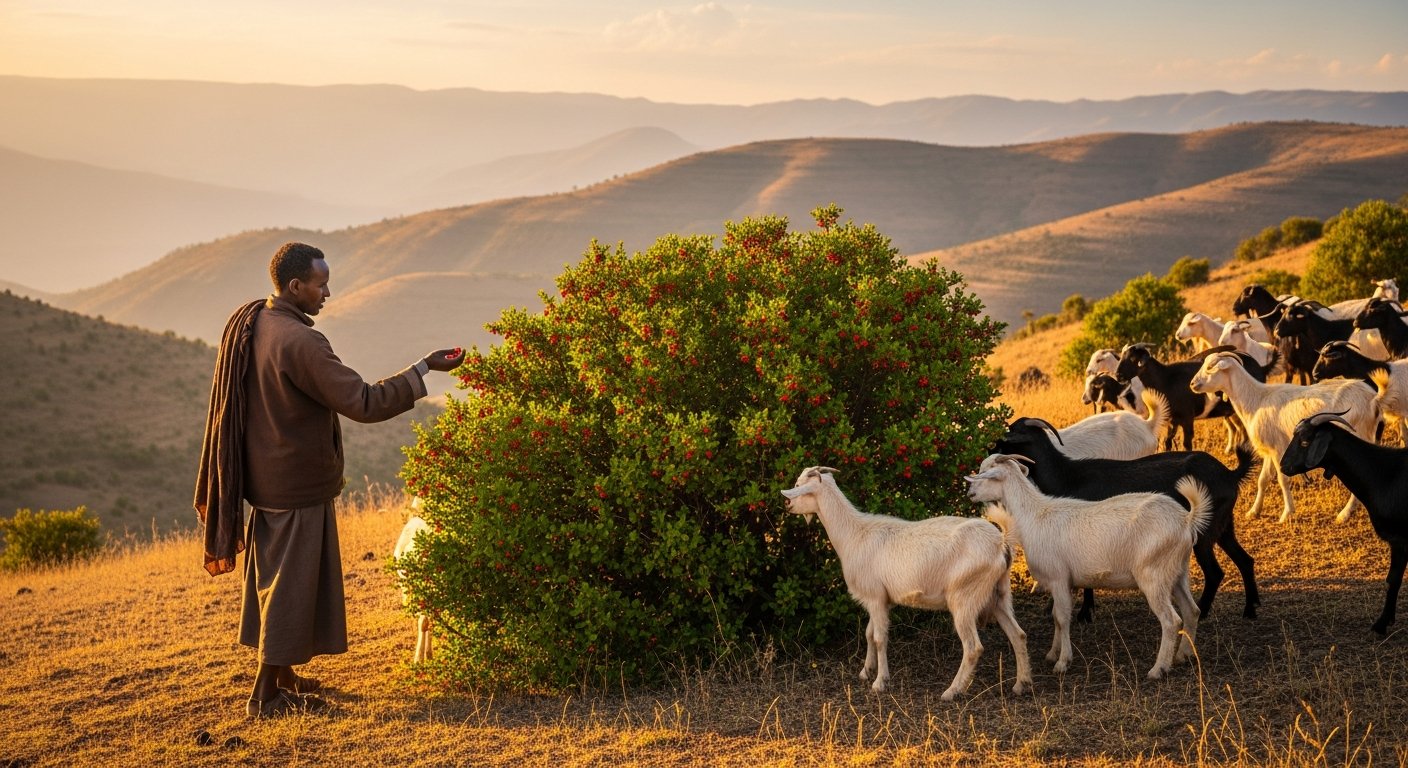
The most famous story of coffee discovery comes from Ethiopia, likely dating back to the 9th century. According to oral tradition, a goat herder named Kaldi noticed his goats behaving strangely after eating red berries from a certain shrub. The animals were full of energy, jumping and dancing instead of resting. Curious, Kaldi tried the berries himself and felt a similar burst of alertness.
Kaldi brought the berries to a local monastery. The monks, however, threw the berries into the fire, declaring them the work of the devil. But as the beans roasted, a rich aroma filled the air. The monks retrieved the beans, crushed them, and steeped them in hot water. The result was the first cup of coffee. The monks found that the drink helped them stay awake during long hours of prayer, and the practice spread from monastery to monastery across Ethiopia.
While this legend is charming, historians caution that it likely emerged centuries after coffee was already in use. No contemporary written records from the 9th century mention Kaldi. The story appears first in the writings of Antoine Faustus Nairon, a 17th-century Roman scholar, who compiled it from earlier oral sources. Nevertheless, the Kaldi legend remains a powerful symbol of the serendipitous nature of discovery and is deeply embedded in Ethiopian cultural identity.
Historical Evidence: Coffee in the Horn of Africa
Leaving legend aside, historical and botanical evidence points to the region of Kaffa in southwestern Ethiopia as the birthplace of Coffea arabica. The word “coffee” itself likely derives from “Kaffa” or from the Arabic “qahwa” (meaning wine). Wild coffee plants still grow in the forests of Kaffa today, and local tribes have chewed coffee berries for energy for centuries, long before brewing became common.
The earliest credible references to coffee consumption come from Yemen, across the Red Sea. By the 15th century, Sufi monks in Yemen were using coffee to stay alert during nocturnal devotions. They prepared a drink called “qishr” from the whole fruit (including the bean), which was less bitter than modern coffee. From these monastic circles, coffee spread to the general population of Yemen, and by the early 1500s, it was being enjoyed in homes and early coffeehouses.
From Yemen to the Ottoman Empire: Coffee Goes Mainstream
The spread of coffee from Yemen into the broader Islamic world marks a turning point in the history of coffee discovery legends and spread. The port city of Mocha (now Al Mokha) became the epicenter of coffee trade. Ships carried green coffee beans from Mocha to ports across the Red Sea, the Persian Gulf, and the Indian Ocean. By the mid-16th century, coffee had reached Cairo, Damascus, and Istanbul.
In Istanbul, the first public coffeehouses, known as “qahveh khaneh,” appeared around 1555. These establishments quickly became centers of social life. Men gathered to drink coffee, play chess, discuss politics, and listen to music. The coffeehouse became known as the “school of the wise” because of the lively intellectual debates that took place there.
Not everyone welcomed this new institution. Conservative religious leaders argued that coffee was an intoxicant, like alcohol, and should be banned under Islamic law. Imams in Mecca attempted to outlaw coffee in 1511, leading to the first of many coffee bans throughout history. The ban failed, however, because the people loved coffee too much. The Ottoman sultan eventually issued a fatwa declaring coffee permissible, and the drink became a cornerstone of Ottoman culture.
European Encounters: Coffee Arrives in the West
European travelers and traders encountered coffee in the Ottoman Empire during the 16th and 17th centuries. Venetian merchants brought coffee beans back to Venice around 1615, where they were sold as a medicinal tonic. The first European coffeehouse opened in Venice in 1645, but it was in England that the coffeehouse truly flourished.
Oxford claims the first coffeehouse in England, established in 1650 by a Lebanese immigrant named Jacob. Two years later, a coffeehouse opened in London, and within decades, there were hundreds across the city. These English coffeehouses were nicknamed “penny universities” because for the price of a penny (the cost of a cup of coffee), a man could enter and engage in learned conversation with scholars, merchants, and politicians.
Women were generally excluded from these early coffeehouses, a fact that led to the “Women’s Petition Against Coffee” in 1674. The pamphlet complained that coffee made men “unfruitful” and that husbands spent too much time away from home. The men responded with a counter-petition defending coffee’s virtues. The debate reveals how deeply coffee had already embedded itself in English social life.
From England, coffee spread to France, Germany, and the rest of Europe. In France, the first Parisian coffeehouse opened in 1672, and the famous Café Procope followed in 1686. Café Procope became a meeting place for the intellectuals of the Enlightenment, including Voltaire, Rousseau, and Diderot. It is often said that the French Revolution was plotted over cups of coffee in such establishments.
The Dutch Take Coffee Global: From Arabia to the Americas
For centuries, the Arabian Peninsula held a monopoly on coffee cultivation. Coffee plants were guarded, and exporters scalded or otherwise sterilized beans before shipping to prevent germination elsewhere. The Dutch, however, were determined to break this monopoly. In 1616, Dutch merchants managed to smuggle a live coffee plant out of Mocha and bring it to the Amsterdam Botanical Garden.
From that single plant, the Dutch began cultivating coffee in their colonies. They established plantations in Ceylon (modern-day Sri Lanka) in the 1650s and later in Java (part of modern-day Indonesia). The success of Javanese coffee was so great that the word “Java” became a synonym for coffee in many languages. The Dutch East India Company became the dominant force in the global coffee trade by the early 18th century.
The Dutch also gave coffee to the French as a gift. In 1714, the mayor of Amsterdam presented a young coffee plant to King Louis XIV of France. This plant was placed in the Jardin des Plantes in Paris. From this single plant descended the entire coffee industry of the Caribbean and Central and South America.
A French naval officer named Gabriel de Clieu stole a cutting from this plant and transported it to Martinique in 1723. The journey was harrowing: he shared his ration of water with the plant during a drought at sea, and he fought off a fellow passenger who tried to destroy it. Once planted in Martinique, the cutting flourished. Within 50 years, there were 18 million coffee trees on the island. From Martinique, coffee spread to Haiti, Jamaica, and other Caribbean islands.
Brazil: The Coffee Superpower
Brazil’s rise as a coffee powerhouse began with a single act of espionage. In 1727, the Portuguese government sent Lieutenant Colonel Francisco de Melo Palheta to French Guiana to mediate a border dispute. His real mission was to obtain coffee seeds. The French governor refused to give him any, but Palheta charmed the governor’s wife, who presented him with a bouquet of flowers hiding coffee seeds and cuttings at a farewell dinner.
With these smuggled plants, Palheta returned to Brazil, and coffee cultivation began in the Amazon region. The climate and soil proved ideal. By the 1830s, Brazil was the world’s largest coffee producer, a position it holds to this day. The boom transformed Brazil’s economy, fueled immigration from Europe, and led to the construction of railroads and ports. It also came at a terrible human cost: slavery was the backbone of Brazilian coffee production until abolition in 1888.
Modern Coffee Culture: The Final Frontier
The 20th century witnessed the industrialization and democratization of coffee. In 1901, Japanese-American chemist Satori Kato invented the first instant coffee. In 1906, George Constant Washington refined the process and began commercial production. Instant coffee became a staple for soldiers during both World Wars, introducing millions to coffee who had never tried it before.
The espresso machine, invented in Italy in 1884 and perfected by Achille Gaggia in 1946, gave birth to modern espresso culture. Starbucks and other chains globalized the coffeehouse model in the late 20th century, transforming coffee from a commodity into an experience. The specialty coffee movement, emphasizing quality, traceability, and direct trade, is the latest chapter in this long history.
Today, coffee is the second most traded commodity in the world after crude oil. Over 2.25 billion cups are consumed daily. The history of coffee discovery legends and spread has evolved from a mythical goat herder’s discovery into a global industry that employs millions. To understand the coffee cultural significance across origin countries and history, one must appreciate how deeply this bean has shaped societies.
Key Takeaways from Coffee’s Journey
Reflecting on this history reveals several enduring lessons about innovation, trade, and culture.
- Serendipity drives discovery: The Kaldi legend reminds us that many of our most beloved foods and drinks were found by accident, not design.
- Monopoly breeds innovation: The Dutch and French efforts to smuggle coffee plants out of Arabia broke a monopoly and reshaped the global economy.
- Coffeehouses are engines of change: From Sufi monasteries to Enlightenment Paris to modern coworking spaces, coffeehouses have always been where ideas are exchanged and movements begin.
- Globalization has a dark side: The spread of coffee was enabled by colonialism, slavery, and environmental exploitation. Modern consumers must reckon with this legacy.
Each of these points invites deeper reflection. For instance, the role of coffeehouses in fostering intellectual exchange is not accidental. The caffeine in coffee sharpens focus, and the social setting encourages conversation. This combination has proven remarkably powerful throughout history.
The Future of Coffee in a Warming World
As we look ahead, the history of coffee discovery legends and spread takes on new urgency. Climate change threatens the regions where arabica coffee grows best. Rising temperatures, unpredictable rainfall, and pests are pushing coffee cultivation to higher altitudes. Farmers in Ethiopia, Colombia, and Vietnam are already feeling the effects.
Scientists are working on developing more resilient coffee varieties, and some producers are experimenting with growing coffee in new regions. The specialty coffee movement has also sparked a renewed interest in sustainable farming practices, direct trade relationships, and the preservation of heirloom varieties. The next chapter of coffee’s story may be written by the choices consumers make today.
From the hills of Kaffa to the cafes of Copenhagen, coffee has traveled an extraordinary path. It has been a medicine, a luxury, a fuel for revolution, and a daily comfort. The history of coffee discovery legends and spread is not a finished tale. It continues to unfold in every cup poured, every farmer’s harvest, and every conversation held over a steaming mug. The next time you drink coffee, remember the goat herder, the monks, the Dutch traders, and the millions of hands that brought that simple berry to your table.